MONDAY MUSINGS SEASON 2 - EPISODE 377
3rd August 2026
#EightfoldPath
Bhuddhism philosophies talk about ‘Eightfold Path’ as the route for liberation. Interestingly Lord Krishna talked about all these eight in different slokas across the eighteen chapters of #BhagavadGita. Let me first explain the ‘eightfold path’.
“Of paths the Eightfold one is best, and of truths the Fourfold. Dispassion is the best of mental states, and of human beings the best is the seer” (#Dhammapada 273)
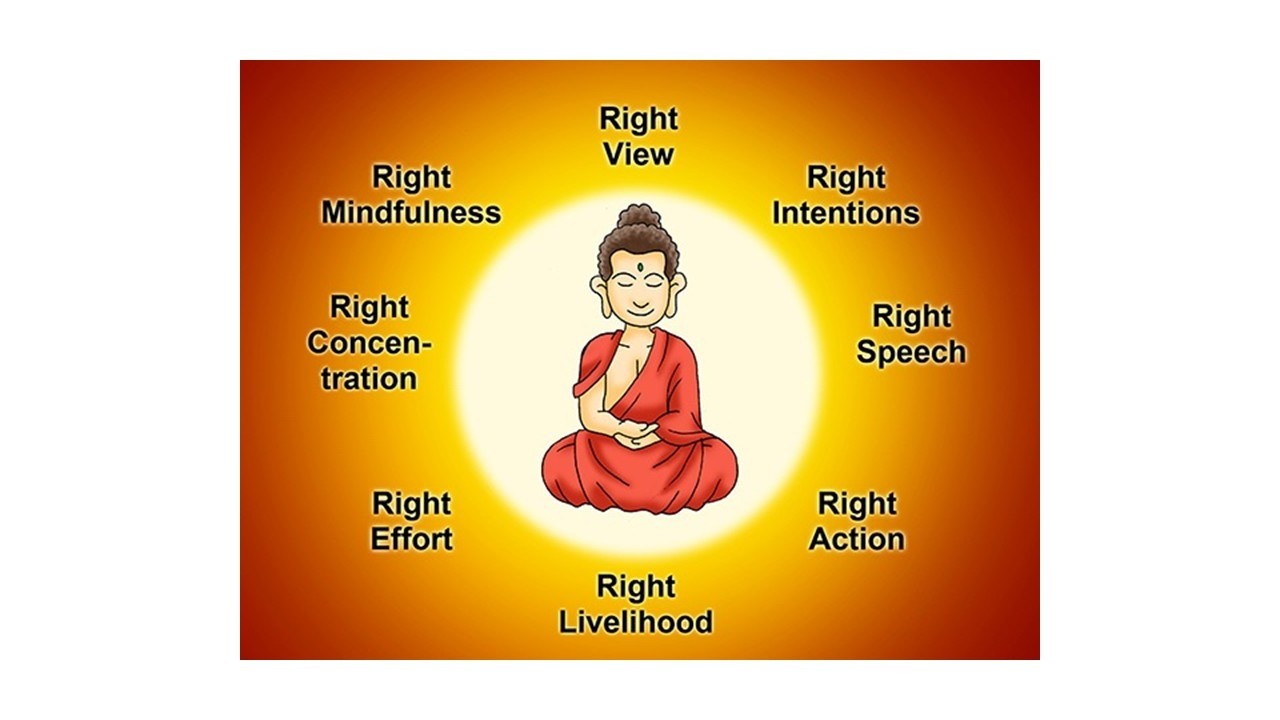
The Eightfold Path consists of:
1. Right View;
2. Right Intention;
3. Right Speech;
4. Right Action;
5. Right Livelihood;
6. Right Effort;
7. Right Mindfulness;
8. Right Concentration.
All of these are interrelated to some extent and many are covered through Bhagavad Gita slokas in the previous episodes of #MondayMusings.
1. Right View – Uchita drishti
Right View does not literally mean ‘Seeing Good things’. View, Drishti, means the faculty of sight, but also includes a person’s view, opinion, or perception of something, and is right view of the right thing, namely the way to live so as to lead to Nirvana, liberation. Right view is the right evaluation of things as well as the right understanding of them.
Right view is seeing things as they really are and knowing which matter and which do not. Naturally this includes a right response to right view, including the right way to live. It is obviously a function of the buddhi, the intelligence, and not the eyes or the emotions. The mind is like a mirror, and if there is any distortion of the mirror then all perceptions will be distorted. So Right View presupposes right condition of the mind. Each of the eight parts of the path is psychological, even if some of them include external modes of behavior.
Thiruvalluvar said the same in a beautiful way in this thirukkural
எப்பொருள் யார்யார்வாய்க் கேட்பினும் அப்பொருள் மெய்ப்பொருள் காண்ப தறிவு. (Thirukkural 423)
Rather than assuming based on whatever seen or heard, wisdom is to discern the truth behind it.
2. Right Intention – Uchita sankalp
Sankalpa means resolution, will, determination, and intention. Obviously Right View is a prerequisite of Right Intention. Right intention, again, is focused on the right subjects–the ones that matter. It controls the direction of our life and the way we will live it. Certainly right intention includes a right understanding of the need to live and act in perfect accordance with the highest standards.
This does not admit of superficiality, mere dabbling, or moseying along through life. Self-discipline is another requisite to carry out Right Intention. The intention to reach the goals is ‘Right Intention’.
3. Right Speech – Uchita vak
Vak is speech–the ability to speak, the intelligence to speak (the thought behind speech), and the speaking itself. It is the last two that are referred to by Buddha. The wellsprings of our speech must be right, both our understanding and intention in speaking. So must our inner speaking, our thinking. Many people will relay a conversation and then say: “But in my mind I said….” Right speech does not allow of disparity between thought and word. Especially it does not allow of anyone thinking spiteful and injurious thoughts inwardly while speaking pacifically outwardly.
There are people who engage in this kind of dichotomy, feeling that “letting off steam” mentally is all right, forgetting that thoughts are realities and powerful vibrations that will certainly damage them if not the persons they are thought about. I have known of people that would regularly tell off or blast away mentally at others, considering that it would be picked up subliminally by their targets and effect changes in their behavior. But this is still violence, an infraction of the law of non-injury (ahimsa).
All speech must be beneficial, true, complete, useful, sincere, and an expression of friendliness (maitreya). Then it will be right in every aspect.
நாநலம் என்னும் நலனுடைமை அந்நலம் யாநலத்து உள்ளதூஉம் அன்று (Thirukkural 641)
Goodness of speech is better than any other goodness.
Rest of the right path will continue in the next episode.
_________________________________________________________________________________________
#PositiveNewsPage
Adapted from newindianexpress.com
With over 25 years of social activism, S Annadurai a social activist from Dindigul, established a school for the Paliyar tribes in Kodaikanal, rescued more than 50 child labourers in Nilakottai, and confronted illegal stone and sand mining in the district.
“My father, Sadamayan, was a farmer in Anaipatti in Nilakottai district, while my mother Santhanam was a homemaker. I grew up in a family with a brother and a sister in Anaipatti. During school days, my attention turned to the Vaigai river, which flowed near our village. Over time, the river’s width had begun to shrink, and this deeply disturbed me,” Annadurai recalls.
As the river narrowed, his questions widened. “The elders in my village and my schoolmates sparked my interest in environmental and ecological safety,” he explains. “Together with my friends, I started planting trees in vacant areas of our village. But many of these trees were cut down by influential people with strong political ties. That reality gradually shaped my thinking.”
His shift towards tribal welfare activism began in 1999, when he attended a camp organised by the Tamil Nadu Pollution Control Board (TNPCB). There, he met local researcher Dr Dakshinamoorthy.
“Later, Dr Dakshinamoorthy sought my help to visit Paliyar tribes in Sirumalai for a research paper, where locals revealed that wealthy individuals had trapped tribal groups as bonded farm labourers.
“I went to the area discreetly and offered help,” he says. “I gave them my mobile number. One day, I received a call saying that the landlords had brutally assaulted them. I immediately went there with a team of social workers and we managed to rescue around 32 tribal workers.”
“A few months later, I started focusing on child rights and education,” he says. “I have been able to rescue more than 50 children from Nilakottai who were engaged as labourers.”
It began with children vanishing from local villages. One disappearance led him to Chellampatti, where a single mother explained that a financier had taken her son to work in an Andhra Pradesh “murukku” factory. She had borrowed Rs 20,000 and could not repay it. Her son had not returned home for three years. Annadurai said that he filed a complaint at a police station and provided them with the address of the factory. In turn, the Andhra Pradesh police traced the boy and brought him back home.
Annadurai’s activism focuses on reshaping futures, notably through a school near Kodaikanal. In 2011, he visited the isolated, malnourished Paliyar families in Pallangi after six children died within weeks. Discovering 32 tribal children had never attended school—the nearest being 13 kilometres away—he raised Rs 5 lakh from friends and relatives to build a local classroom. To overcome initial family hesitation and build trust, Annadurai distributed hens and goats. Supported by local teacher Pandiyammal, who volunteered to conduct classes, the school successfully opened doors for the community. In 2018, the school education department took over the administration of the school. Two more teachers were appointed, and additional classrooms and toilets were built.
For Annadurai, the river that disrupted his childhood still flows through his work, now choked by quarrying and mining dust. Following years of protest against illegal sand mining by local elites in Nilakottai, he successfully pushed authorities to increase surveillance and seize dozens of vehicles.
Annadurai strongly advocates for social activism to be included as a subject in the school curriculum. To him, activism should not be an accident that happens when someone stumbles upon injustice. It should be a taught, nurtured skill. His own path suggests what might be possible if more students learn what he learnt the hard way: that the distance between witnessing and intervening is just one decision.
_____________________________________________________________________
Conceived, compiled and posted as a weekly motivational newsletter #MondayMusings by Jaganathan T (www.authorjaganathan.com)
______________________________________________________________________
PROMOTION
