MONDAY MUSINGS SEASON 2 - EPISODE 367
25th May 2026
Mindful Middle Path
Happiness is real when it originates from self-knowledge and intellect, and is not driven by a lack of intellect and leaving the control to the senses. Lord Krishna describes one more type of happiness ie happiness in the mode of ignorance in the next sloka ie 18.39
Sleep, Lethargy and Carelessness – Illusory happiness
यदग्रे चानुबन्धे च सुखं मोहनमात्मन: | निद्रालस्यप्रमादोत्थं तत्तामसमुदाहृतम् || Bhagavad Gita 18.39||
That happiness which is illusory from the beginning to the end, which is derived from sleep, indolence, and negligence, is said to be in the mode of ignorance.
Three Sanskrit words are important to understand here and they are nidra, alasya and pramada, all the three are simple words. Nidra means sleep, alasya translates to laziness and pramada to negligence / carelessness.
What connects these three traits? All these three feel like happiness when attempted but they are not true happiness. You may feel like you are happy, but the happiness is illusory. They are worse than temporary happiness, happiness derived from enjoying the merger of senses with sense objects. Enjoyment from sleep, laziness and carelessness are illusory. For the person in the mode of passion there might be some kind of ephemeral happiness in the beginning and at the end distress, but for the person in the mode of ignorance there is only distress always, beginning as well as in the end.
Tāmasic happiness is of the lowest kind and is foolishness from the beginning to end. And yet, since there is a tiny experience of pleasure in it, people get addicted to it.
Too much and Too little – both are bad
Sleep is essential for the body. Human physiology suggests that 8 hours of sleep per day is essential for growth. Is sleep good or not good? Lord Krishna gives the answer to that question as well, not in one sloka, but in two slokas
O Arjun, those who eat too much or too little, sleep too much or too little, cannot become a yogi - (Bhagavad Gita 6.16)
those who are temperate in eating and recreation, balanced in work, and regulated in sleep are Yogis and they can mitigate all sorrows – (Bhagavad Gita 6.17)
Yogi can mitigate all sorrows and can achieve eternal happiness.
The opposite of Yog is bhog, which means engagement in sensual pleasures. Indulgence in bhog violates the natural laws of the body, and results in rog (disease).
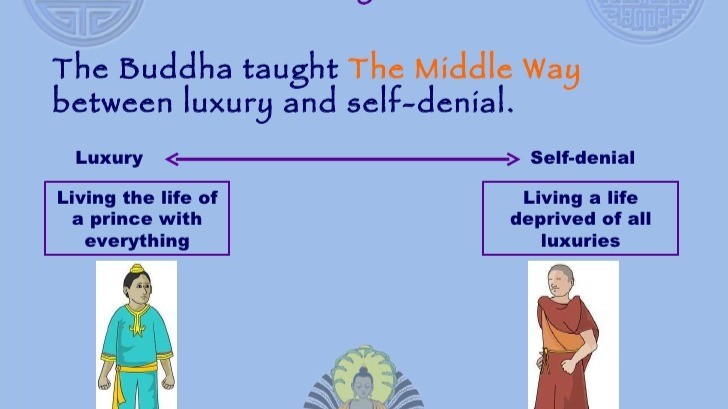
Middle Path
This story, attributed to Gautam Buddha, explains how Gautam Buddha discovered the importance of balance, the middle path-a way to rise above suffering and find inner peace, through a simple song sung by local women.
Before his enlightenment, Prince Siddhartha (who would become the Buddha) left his palace to find the truth behind human suffering. Believing that strict self-denial and severe austerity were the keys to spiritual liberation, he began to fast and meditate rigorously. Over time, he grew incredibly weak, thin, and dizzy, to the point where he couldn't steady his mind.
One day, a group of village women walked past him, carrying water pots on their heads and singing a folk song. The lyrics were simple but profound:
· "Tighten the strings of the tanpura (Indian classical string instrument)... But do not tighten them so much that the strings break."
Hearing these words, a profound realization struck the Buddha. He realized that torturing his body with extreme starvation (over-tightening the strings) was doing more harm than good and would not lead to enlightenment. However, indulging in a life of luxury (leaving the strings too loose) would also not yield harmony.
This simple song taught him a foundational concept of Buddhism, #MiddlePath. It emphasizes a life of balance, moderation, and mindfulness—caring for the body just enough to keep it healthy while keeping the mind focused on spiritual growth.
Finding the Middle Path fits very well in Leadership Traits as well. Leaders have to find the Middle Path in many aspects, including neither being too strict nor too lenient with the subordinates.
____________________________________________________________________________________
#PositiveNewsPage
Adapted from newindianexpress.com
For thousands of government school students in Bihar’s Vaishali district, District Magistrate #VarshaSingh is not known simply as an IAS officer or DM. She is “Hamari Collector Didi” — a mentor, guide and trusted elder sister. Widely described as milansar, or warm and approachable, Singh has developed an unusually close connection with the girls, boys and women across both rural and urban areas of the district.
In Bihar, district magistrates are popularly referred to as collectors or DMs, but in Vaishali, the term now carries an added sense of warmth because of Singh’s distinctive style of governance, rooted as much in empathy as in administration.
Whether addressing students during school visits or interacting with women in villages, Singh often refers to them affectionately as the district’s betiyaan and bete. That emotional bond has transformed her image from that of a conventional bureaucrat into a trusted elder sister figure for the district’s youth.
Ms. Singh carves out nearly four hours every week exclusively for interacting with students under a pioneering initiative titled “Hamari Collector Didi”. Conducted twice a week in online and offline formats, the programme has evolved into a platform for confidence-building, counselling and career guidance.
The idea emerged during Singh’s regular visits to schools across the district. As part of her mission to improve the educational environment in government institutions, she frequently interacted with the students, sat among them in classrooms and even shared midday meals with them.
The initiative has also emerged as a platform for spreading awareness against child marriage. During interactive sessions, students are educated about the legal age of marriage, the importance of education and the need for girls to make independent decisions about their future.
Another focus of Singh’s mentorship sessions is communication and personality development. Students are encouraged to speak confidently, express their opinions openly and develop leadership qualities.
The impact of her efforts is becoming increasingly visible. Singh’s compassionate approach to governance is drawing praise.
Determined to make competitive examination preparation more accessible for government school students, Singh has also launched a subsidiary initiative linked to “Hamari Collector Didi”. Under this programme, government high schools are being provided with syllabi and previous years’ question papers for exams such as NEET, MBA entrance tests, etc.
___________________________________________________________________________________
Conceived, compiled and posted as a weekly newsletter #MondayMusings every Monday in Linkedin by Jaganathan T (www.authorjaganathan.com).
___________________________________________________________________________________
PROMOTIONS
