MONDAY MUSINGS SEASON 2 - EPISODE 362
20th April 2026
Kintsugi
The intellect is said to be in the nature of goodness, O Parth, when it understands what is proper action and improper action, what is duty and non-duty, what is to be feared and what is not to be feared, what is binding and what is liberating (Bhagavad Gita 18.30)
Can fear be positive?
Lord Krishna suggests that intelligence is in knowing what is to be feared and what is not to be feared. Can fear be helpful?
At the basic level fear guides our fight or flight responses and helps to keep us safe and alive. Fear heightens our senses and awareness; it keeps us alert and helps in better preparation.
The negative side of fear is when it holds us back from doing something positive.
Too much fear is like trying to climb a mountain with excess baggage on your back – you might have to dump some or abort the adventure. To achieve great potential or greater heights – have fear and still push through it.
Read this interesting and inspirational story from ancient Japan.
Taro’s fear of failure
Taro was a young and brave samurai. He had been wandering for days since his Lord’s death, as he felt remorse that he could not save his Lord.
He lost all sense of direction and purpose in his life. One day, while passing through a forest, he saw a Buddhist monk meditating peacefully on a rock by the side of a waterfall. Taro stopped there, and the monk looked at him with a warm smile, offering him a place to sit. The monk observed him silently for a moment before speaking. "I notice a great sadness in you, young samurai" the monk asked smilingly.
“What troubles you?” the monk asked.
Taro hesitated for a moment before confessing. “I failed to protect my Lord. He died because of my incompetence, and I have brought shame upon myself and my family”.
The monk listened patiently to Taro and asked, “Does that mean you failed in your duties?”
“Yes, I think I wasn’t worthy to be a samurai” Taro replied.
“I think you don’t know about the philosophy of #kintsugi” the monk asked.
“No, I don’t” Taro said.
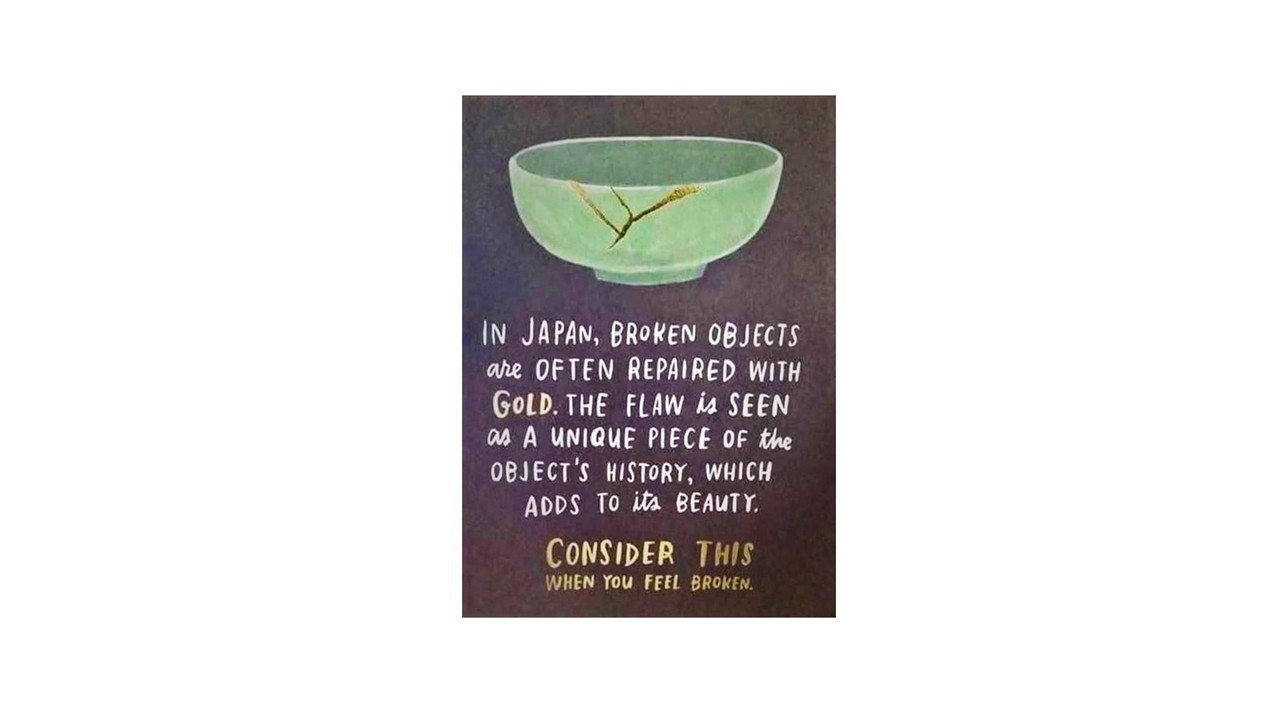
“We do not throw when a pottery breaks, we mend it back with gold lacquer”
“Why?”
“This philosophy is known as #kintsugi”. “Kintsugi, meaning ‘golden joinery’ is the centuries-old Japanese art of repairing broken pottery by mending cracks with lacquer mixed with powdered gold, silver, or platinum. Rather than hiding damage or throwing away the damaged object, this technique highlights repairs, celebrating an object’s history, imperfections, and resilience, making the broken piece more unique and beautiful” the monk explained.
Taro looked at the monk in confusion, unsure of what kintsugi had to do with his predicament.
“You are like the broken pottery”, the monk continued. “You have been shattered by your failures and mistakes, but that does not mean you are worthless. On the contrary, it is through your brokenness that you can become even more beautiful and valuable. The gold that fills the cracks in the pottery is like the wisdom and strength you can gain from your experiences”.
Taro listened intently to the monk’s words, feeling the glimmer of hope rise within him. The monk’s philosophy made sense to him, and he realized that he had been too focused on his shame and failure to see the potential for growth and redemption.
“I have been so focused on my failures that I forgot about the lessons I can learn from them. I will seek out new opportunities to serve my country and redeem myself”. Taro nodded, feeling the newfound sense of determination.
He left that place, feeling grateful for the monk’s wisdom, and eager to embark on a new path of redemption. Remember, your failures and mistakes do not define you. They only serve to make you stronger and more resilient.
Embrace your brokenness and fill it with motivation and knowledge from your experiences, and you will become more beautiful and valuable than before for future opportunities.
_________________________________________________________________________
#PositiveNewsPage
I had the opportunity to read a very interesting and inspirational book written by my professional friend Dr. Shekhar Pawar. This week’s positive news is about this inspirational book.
The book titled “Air Team Theory” is about 'Understanding 10 Types of Team Mates and Best Practices to succeed in a team'.
According to Dr. Pawar, every team consists of people, who bring glory, as well as negative VIRUSES, who contribute to the poisonous pollution at the workplace.
Just like dry air has ten types of gas components, each with distinctive characteristics, every team has different types of teammates with unique characteristics. Want to identify the Nitrogen (N2), Oxygen (O2), Argon (Ar), Hydrogen (H2), Methane (CH4), Krypton (Kr), Helium (He), Neon (Ne), Xenon (Xe) and Carbon Dioxide (CO2) within your team? Check out the Air Team Theory!
The Air Team Theory compares the characteristics of each teammate type to the characteristics of each gas. It shares scenarios, conversations and behavior patterns of different teammate types. This book also shares the best practices and experiences to effectively lead all the ten types of teammates as one team.
This book is for you if you are either a team member or a manager or a director or from top management or an entrepreneur or a leader working with any type or size of team.
Most of you will see yourself and even your teammates in at least one of the teammate types explained in this book. The book will make you smile and even bring different emotions to your face as you recall bitter and sweet instances that have happened at your office. It provides useful recommendations and proven solutions for any leader to increase the productivity of any team using simple tips and techniques.
Purchase in Amazon - https://www.amazon.com/Air-Team-Theory-Understanding-Practices/dp/1647606918
_________________________________________________________________________________________________
PROMOTIONS


