MONDAY MUSINGS SEASON 2 - EPISODE 356
9th March 2026
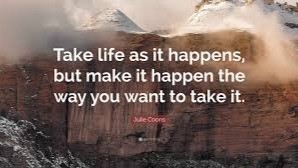
Take life as it comes
WISHING EVERYONE HAPPY WOMEN’S DAY
That knowledge is to be considered in the mode of passion (rajasam) by which one understands that (different experiences/knowledge in this world) for all the living entities are unconnected. (Bhagavad Gita 18.21)
Intelligent people think that every experience is valuable and has the potential to connect for good in the future. Every knowledge is valuable, and an unassailable faith is required that everything happening to us will be for good.
Everything Happening is for our own GOOD
We must develop a strong belief that ‘Everything happening is for our own good’. The difference can be between ‘expected outcome’ and ‘unexpected outcome’, but all are good outcomes. Is it possible to always think that everything is happening for our good? Yes, Possible. We will see the story of a great man who proved this.
We see ourselves as separate from life around us, and this creates constant calculation and judgment. Events we like are labelled 'good'; those we dislike are 'bad'. With Enlightenment comes Equanimity, and we transcend karma. We transcend judging, joyfully reintegrating with life.
Weathering adversity by staying connected to GOD and developing resilience are incredibly important character traits.
There were many ‘Blessing in Disguise’ moments in the life of Steve Jobs, Co-Founder and CEO of the most valuable company Apple Inc. He explained ‘Connecting the Dots’, in a commencement address at Stanford University on June 12, 2005.
Connect Calligraphy to Computer Design
Steve’s biological mother, Joanne Schieble put him up for adoption when he was born. She set a condition that she would give the child only to an educated parent. She selected a lawyer and his wife based on that criterion, but they changed their minds and decided to look for a girl child. Unlucky for them.
Paul and Clara Jobs preferred a boy and applied. But they did not meet Joanne's requirements, as neither had a college education.
Joanne agreed to give the child to the Jobs after obtaining a promise before the court that the child would be provided with a college education. Thus, this child became STEVE JOBS, born to an unwed mother, to transform the face of technology.
Steve became famous for playing pranks at the school. His pranks got quite dangerous when he was in third standard and he was sent back home many times. But his parents never scolded him. His father told the school, “If you can’t keep him interested, then it’s your fault”.
When he was in fourth grade, his teacher, Imogene Hill realized his potential and helped turn him around "I want you to finish this workbook, and if you do so, I will give you 5 bucks". The teacher kindled Steve's passion for learning new things.
Steve naively chose Reed College, which was almost as expensive as Stanford, and all of his working-class parents’ savings were being spent on college fees. Steve got bored with the classes after 6 months of joining the college. He did not see any value in spending his parents’ hard-earned money on a college education.
He had no idea what he wanted to do in his life, and how the college would help him to find that out. Therefore, he decided to drop out of college but then stayed around as a drop-in for another 18 months.
He had to vacate his room, so he slept on the floor of his friend's room. He used to collect empty Coke bottles for 5 cents to buy food. He used to walk 7 miles through the town every Sunday night to get a good meal at the Hare Krishna Temple but he did not get disheartened. He took life as it came.
Steve quoted in his speech, “It was pretty scary at that time, but looking back at it, this was the best decision I ever made. Much of what I stumbled into, by following my curiosity and intuition, turned out to be priceless later on”.
Reed College at that time offered perhaps the best calligraphy instruction in the country. Because Steve had dropped out and didn’t have to take the normal classes, he decided to take a calligraphy class. He learned about serif and sans-serif typefaces, about varying the spacing between different letter combinations, and about what makes great typography. He found it fascinating.
Steve confirmed in his speech, “None of this had even a hope of any practical application in my life. But ten years later, when we were designing the first Macintosh computer, it all came back to me. And we designed it all into the Mac. It was the first computer with beautiful typography. If I had never dropped in on that single course in college, the Mac would have never had multiple typefaces or proportionally spaced fonts. And since Windows just copied the Mac!, it’s likely that no personal computer would have them”.
“You have to trust in something: your gut, destiny, life, karma, whatever. Believing that the dots will connect down the road will give you the confidence to follow your heart, even when it leads you off the well-worn path. And that will make all the difference”.
“You can't connect the dots looking forward; you can only connect them looking backwards. So you have to trust that the dots will somehow connect in your future. You have to trust in something” – Steve Jobs.
Steve Jobs believed that the dots would somehow connect, and he made history. Will you?
_____________________________________________________________________________
#PositiveNewsPage
Today is ‘International Women’s Day’ and the honour for today’s Positive News Page goes to an Indian woman achiever, who fought against odds, won and empowered women.
First Women Engineer
Born in 1919 in a middle-class Telugu family in Chennai, A Lalitha was the fifth of seven siblings. Her brothers had become engineers, while her sisters were limited to basic education. Despite being married off at the age of 15, her father believed in her education and ensured she completed her studies up to Class 10.
Lalitha lost her husband at the age of 18 and faced pressure from the family and the society to adapt to tough widowhood - shaved head, a strictly restricted life, and banishment from society. However, Lalitha decided not to succumb to societal pressures. She chose to become an engineer like her father and her brothers.
Rao, a professor of Electrical Engineering at the College of Engineering, Guindy (CEG), University of Madras, spoke to K C Chacko, the principal of the college and to the director of Public Instruction, R M Statham. Both officials were supportive of admitting a woman, a first in CEG’s history.
The students at the college were extremely supportive. She was the only girl in a college with hundreds of boys, but no one ever made her feel uncomfortable; we need to give credit to this. She left her daughter in her brother's care while studying and would visit her on weekends.
She worked for a brief period with the Central Standard Organisation in Shimla. Later, she also worked with her father in Chennai, assisting him in inventing Jelectromonium, an electrical musical instrument, an electric flame producer, and smokeless ovens. But within nine months of joining her father’s workshop, Lalitha took up a job in the Associated Electrical Industries in Kolkata.
The pioneering spirit that did not end with her degree
Lalitha continued to make significant contributions to her field throughout her life. In her 20-year career, she worked for several organisations, including the Central Standard Organisation, Associated Electrical Industries, and the Indian Standards Institution. She also served as a consultant to the United Nations on engineering projects in Sri Lanka, Nepal, and Bangladesh.
Apart from her professional career, she was also involved in several women's organisations — including the All India Women’s Conference and the National Federation of Indian Women. She was a vocal advocate for women’s rights and gender equality and believed that women should have equal access to education and employment opportunities. She worked tirelessly to promote these ideals.
Lalitha was eventually recognised for her contributions to engineering and women’s rights. She was also invited to attend the First International Conference of Women Engineers and Scientists at the 1964 New York World's Fair, where she represented India. Here’s where she had very famously said, “150 years ago, I would have been burned at the funeral pyre with my husband’s body.”
Lalitha took life as it came and rewrote history.
____________________________________________________________________________________________
Conceived, compiled and posted as a positive newsletter #MondayMusings every Monday by Jaganathan T (www.authorjaganathan.com)
___________________________________________________________________________________________
PROMOTIONS

Email enquiries to radhikasingh@myperito.com
SELECT & DELETE
Where IT meets Healthcare and crime
Select & Delete is a fascinating and engaging crime fiction that explores the interplay of technology, healthcare and politics. The story spans two generations of a family, set against the rapid changes in Information Technology from 1985 to 2025, from mainframe computing & punched cards to cybercrime and Agentic AI.
What starts as an innocuous systems audit at Vikas Hospital on 12th May 1995 develops into an unexplainable mystery. A system audit reveals system inefficiencies but this system audit revealed a murky affair at the hospital. The auditor, Vasudevan, was determined and enthusiastic about pursuing the trail at the beginning, but for some strange reason decided to drop it and took up the investigation after 30 years. Why? The baton then passes to his daughter and her friend. Would they unravel the mystery? Don’t SELECT and READ. Read ‘in-one-go’ and enjoy the twists and turns.