MONDAY MUSINGS SEASON 2 - EPISODE 352
9th February 2026
Comfort Zone or Growth
Those who neither avoid disagreeable work nor seek work because it is agreeable are persons of true renunciation. They are endowed with the quality of the mode of goodness and have no doubts (about the nature of work). (Bhagavad Gita 18.10)
Sticking to agreeable work and avoiding work that involves toil, new knowledge, possible risk, etc is #ComfortZone as per #BhagavadGita.
“A ship is always safe at the shore-but that is not what it is built for” – Albert Einstein
“Do one thing every day that scares you.” – Eleanor Roosevelt
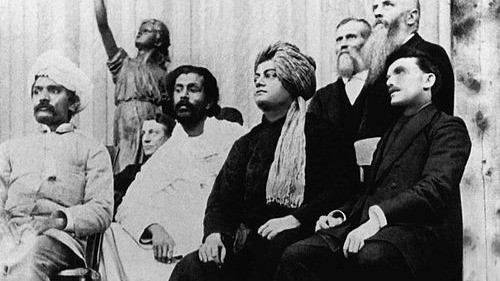
Swami Vivekananda’s arduous journey to fame
Swami Vivekananda travelled throughout India but never ventured outside India before that unique remarkable journey. May 31, 1893, marks a red-letter day in the history of India. On this day, Swami Vivekananda set sail from Mumbai (then Bombay) aboard the S.S. Peninsular to represent Sanatana Dharma (Eternal Religion) and India at the World's Parliament of Religions in Chicago. If Swami Vivekananda had worried about his comfort zone, the world would have missed the opportunity to hear the pearls of sanatanic wisdom.
He heard about an international conference of religions at USA. He did not get a formal invitation to speak at the conference. Swami was a monk and did not have the money to travel either. He did not even have the necessary clothes to get him through the tough journey and the conference requirements. But these impediments did not deter him from his determination to speak at the conference.
The idea of the ‘parliament of religions’ scheduled for September 1893 was to gather all the religions of the world to show "the substantial unity of many religions in the good deeds of the religious life. The Brahmo Samaj and the Theosophical Society were invited as the representatives of Hinduism. Swami as a true follower of the #BhagavadGita, prepared the plans for the challenging work in front of him.
First impediment was the money needed for the mission. As a monk, he did not keep any money for new ventures. Swami Vivekananda’s trip to the USA was primarily funded by voluntary donations from his devoted followers in Madras (now Chennai) and by contributions from various Indian royalty. Young admirers and disciples in Madras, including Azhagiyasingha Perumal, raised money through public subscriptions to cover travel costs, collecting approximately ₹4,000 for a second-class ticket and additional amounts for expenses. The wife of Azhagiyasingha Perumal sold her jewellery to help fund the trip. The Raja of Ramnad and the Maharaja of Khetri provided significant financial assistance.
His journey finally started on 31st May 1893. His journey took him through Colombo, Singapore, Hong Kong, and Japan, across the Pacific Ocean to Vancouver, Canada reaching Vancouver in July 1893 before arriving in Chicago. During this journey, aboard the S.S. Empress of India (from Yokohama to Vancouver), he met Jamsetji Tata. The two engaged in a profound discussion on the future of scientific education and research in India—an exchange that later influenced Jamsetji’s vision for establishing the Indian Institute of Science. Tata had established one of India's first textile mills and was on his way to Chicago to gather new business ideas.
Reached but no admission
After reaching Chicago, Vivekananda learned that no one could attend the Parliament of the World's Religions as a delegate without proper credentials. As he did not have these at the time, he felt deeply disappointed. He also discovered that the Parliament would not begin until the first week of September which means he needed more money to meet the expenses.
Despite these challenges, Vivekananda did not lose hope. To reduce his expenses, he decided to travel to Boston, as it was less costly than staying in Chicago.
In Boston, Vivekananda met #ProfessorJohnHenryWright of Hardvard University, who invited him to deliver a lecture at the university. Impressed by Vivekananda's knowledge, wisdom, and eloquence, Professor Wright strongly encouraged him to represent Hinduism at the Parliament of the World's Religions.
When Wright learned that Vivekananda lacked official accreditation and credentials to join the Parliament, he remarked, "To ask for your credentials is like asking the sun to state its right to shine in the heavens.
#FamousSpeech
The Parliament of the World's Religions opened on 11 September 1893 at the #ArtInstituteOfChicago. On this day, Vivekananda delivered a brief speech that represented India and Hinduism. He bowed to Goddess Saraswati and began his speech with an iconic salutation "Sisters and brothers of America”. At these words, Vivekananda received a two-minute standing ovation from the crowd of seven thousand. When silence was restored, he began his address, greeting the youngest of the nations on behalf of "the most ancient order of monks in the world, the Vedic order of sannyasins, a religion which has taught the world both tolerance and universal acceptance. Vivekananda's speeches at the Parliament had the common theme of universality, emphasising religious tolerance.
Vivekananda attracted widespread attention in the press, which called him the "cyclonic monk from India". The New York Critique wrote, "He is an orator by divine right, and his strong, intelligent face in its picturesque setting of yellow and orange was hardly less interesting than those earnest words, and the rich, rhythmical utterance he gave them"
On another occasion, he described his mission thus: I do not come to convert you to a new belief. I want you to keep your own belief; I want to make the Methodist a better Methodist; the Presbyterian a better Presbyterian; the Unitarian a better Unitarian. I want to teach you to live the truth, to reveal the light within your own soul.
Vivekananda's success led to a change in mission, namely the establishment of Vedanta centres in the West. That was possible only because Swami Vivekananda was ever ready to step out of the ‘Comfort Zone’.
“If you want something you’ve never had, you must be willing to do something you’ve never done.” – Thomas Jefferson
_________________________________________________________________________________
Conceived, compiled and posted as a weekly positive newsletter #MondayMusings every Monday by Jaganathan T (www.authorjaganathan.com)
___________________________________________________________________________________
PROMOTIONS
