MONDAY MUSINGS SEASON 2 - EPISODE 351
2nd February 2026
Life begins at the end of your comfort zone
#ComfortZone is a modern management concept, but Lord Krishna was aware of the need to step outside the comfort zone for growth, and hence dedicated one sloka in #BhagavadGita to the same. Before understanding the sloka:
What is a comfort zone?
Comfort Zone is not cosy and deluxe working and living conditions.
The phrase ‘comfort zone’ was coined by management thinker Judith Bardwick in her 1991 work #DangerInTheComfortZone:
The comfort zone is a behavioral state within which a person operates in an anxiety-neutral condition, using a limited set of behaviors to deliver a steady level of performance, usually without a sense of risk.
Within the comfort zone, there isn’t much incentive for people to reach new heights of performance. It’s here that people go about routines devoid of risk, causing their progress to plateau.
To grow, individuals are encouraged to step into the #OptimalPerformanceZone, which lies just outside the comfort zone, where stress is high enough to motivate but not so high that it causes panic.
#YerkesDodsonLaw
In 1907, Robert Yerkes and John Dodson conducted one of the first experiments that illuminated a link between anxiety and performance.
They saw that mice became more motivated to complete mazes when given electric shocks of increasing intensity – but only up to a point. Above a certain threshold, they began to hide rather than perform. Similar behaviour was observed in humans as well.
They developed the Yerkes–Dodson Law, which states that performance increases as stress increases, and performance decreases as stress decreases. However, at a certain point, high levels of stress inhibit performance.
The Yerkes–Dodson Law is true not only for more tangible forms of performance, such as taking on a stressful new task at work, but also in many other areas of life, including understanding ourselves, relating to others, and so on.

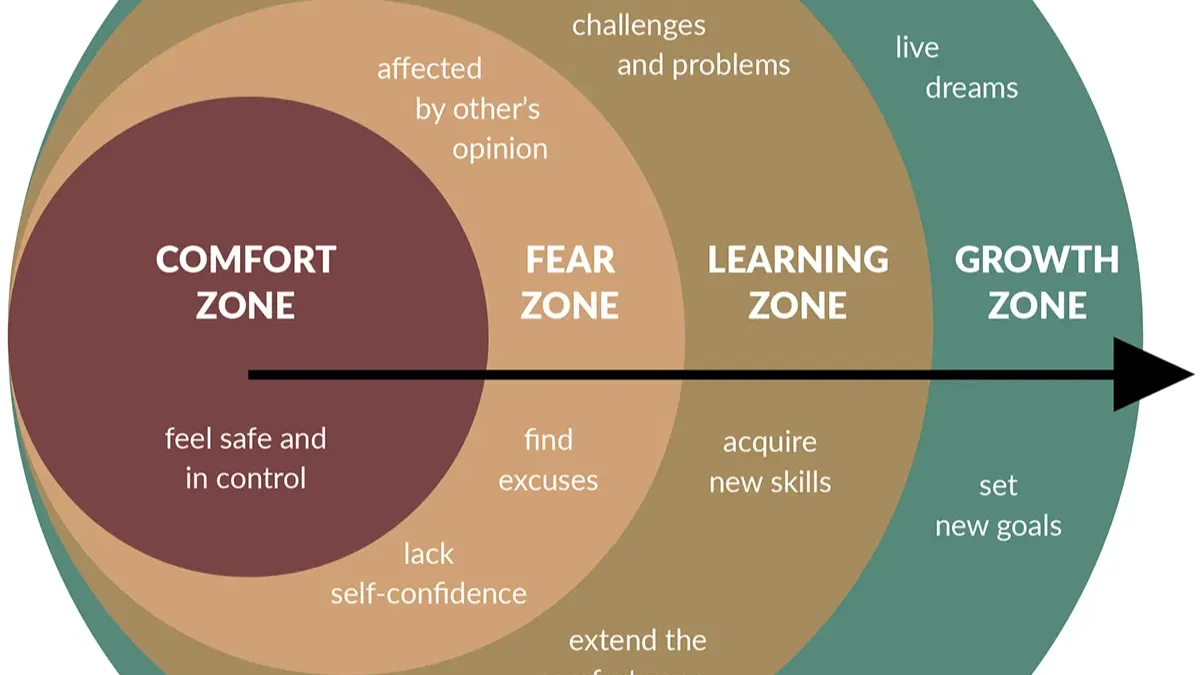
The core idea is that our nervous systems have a Goldilocks zone of arousal. Too little, and you remain in the comfort zone, where boredom sets in. But too much, and you enter the ‘panic’ zone, which also stalls progress:
It takes courage to step from the comfort zone into the fear zone. This can be anxiety-provoking. Yet persevere long enough, and you enter the learning zone, where you gain new skills and deal with challenges resourcefully.
After a learning period, a new comfort zone is created, expanding one’s ability to reach even greater heights. This is what it means to be in the growth zone. It’s important to note that, as with most attempts at behavioural change, moving into the growth zone becomes harder without some level of self-awareness.
Leaving aside the quotes, is it easy to step outside the comfort zone? Definitely not. As humans, we’re wired for survival, and naturally shy away from those perceived threats as much as we can.
If you’re not growing or learning new things, you’re not taking chances in your life, you’re not fulfilling your goals or dreams. If you find yourself wondering why you’re not accomplishing things you want to accomplish — making new friends, getting better grades — then it’s time to look at areas where you might be a little too comfortable and passive.
However, it’s also not healthy to push yourself too far all the time. Being in a constant state of high stress can take its toll; humans need to return to the safety of their comfort zone every so often.
Now the sloka:
न द्वेष्ट्यकुशलं कर्म कुशले नानुषज्जते | त्यागी सत्त्वसमाविष्टो मेधावी छिन्नसंशय: (Bhagavad Gita 18.10)
Those who neither avoid disagreeable work nor seek work because it is agreeable are persons of true renunciation. They are endowed with the quality of the mode of goodness and have no doubts (about the nature of work).
Kushalam means happiness, wellness, comfort. Lord Krishna refers to not being satisfied with the comfort zone by the reference kushale karma.
Lord Krishna’s advice – Wise men would not get attached to their comfort zone and would be ready to seek new & manageable risky avenues for better learning and would not have any doubts about their goals and strategy.
What foresight!
_______________________________________________________________________________
#PositiveNewsPage
Adapted from https://www.newindianexpress.com/
In the sun-scorched district of Perambalur, a modest five-acre patch of land beside Valikandapuram Higher Secondary School lay unused for years, except as a dumping ground for students' sullage. In a region known for its rich red soil and thriving paddy and sugarcane crops, the plot stood as a contradiction.
That changed in 2023 with the arrival of Dr D M Anantharaja, a science teacher from nearby Ayyalur village. It did not take long for him to recognise the untapped potential of the dormant land. Believing the plot could act as a receptacle for the sullage, he convinced headmaster G Selvaraj to reuse the water for cultivation.
They started modestly by planting just two banana saplings. To their surprise, the plants flourished. Encouraged by this growth, they registered the school with the Thesiya Pasumai Padai, also known as the National Green Corps (NGC), and 62 students signed up for organic farming.
“Under the NGC, students are divided into groups, and each group takes care of specific activities such as planting, watering, composting and harvesting. We use co-curricular periods so that academics are not affected,” the headmaster said.
NGC members began utilising the land in 2023 by sowing seeds of tomatoes, brinjals, country lady’s finger, lablab beans, green chilli, pumpkin and ash gourd. “By involving students in organic farming, we aimed to connect classroom learning with real-life experience,” Anantharaja said.
The teachers then implemented a phased development plan from 2023 to 2024 across the school grounds. It began with creating a thongum thottam (hanging garden) over 15 cents to cultivate bottle gourd, snake gourd, ridge gourd and bitter gourd. A kaaikari thottam (vegetable garden) filled another 25 cents. In the next phase, five cents of land was dedicated to herbal plants, while fruit-bearing trees such as banana, papaya and lemon covered the pazha thottam across 20 cents. Around 120 native saplings, including neem, peepal and pungam, were planted across 15 cents.
A vermicompost unit was later set up on two cents to supply organic manure for the entire cultivation. As more teachers became proactive, there were more hands on the farm.
An additional three cents of land was later dedicated to herbal plants, including Calotropis gigantea, Andrographis paniculata, Phyllanthus amarus, Justicia adhatoda and Piper longum. Name boards for each species, along with their medicinal uses, were put up for students’ learning.
In the early days, the teachers spent money from their own pockets on the farm. The following year, recognising the school’s commitment to sustainability, the Department of Environment and Climate Change under the Tamil Nadu Climate Change Mission selected it for the Green School Scheme (Pasumai Palli Thittam) 2024–25, which enabled the sanction of up to `20 lakh in funds for further environmental initiatives.
To sustain engagement, teachers implemented farm-centred programmes. “Students now know how food is grown, the importance of soil health and the value of native plants,” the science teacher said.
Teachers also mark environmental days with awareness programmes. “What makes this project successful is collective ownership; students feel responsible for the campus. This model proves that with commitment, even rural schools can become centres of environmental leadership,” Selvaraj said.
Every time the students plant and harvest, they form a bond with the soil. Reflecting this change, Nagulan added, “Eating vegetables grown by our own hands feels special. This initiative has changed how we view nature and inspired many of us to start small home gardens”.
_______________________________________________________________________
Conceived, compiled and posted as a weekly inspirational newsletter #MondayMusings every Monday in LinkedIn by Jaganathan T (www.authorjaganathan.com)
_______________________________________________________________________
PROMOTIONS
