MONDAY MUSINGS SEASON 2 - EPISODE 345
22nd December 2025
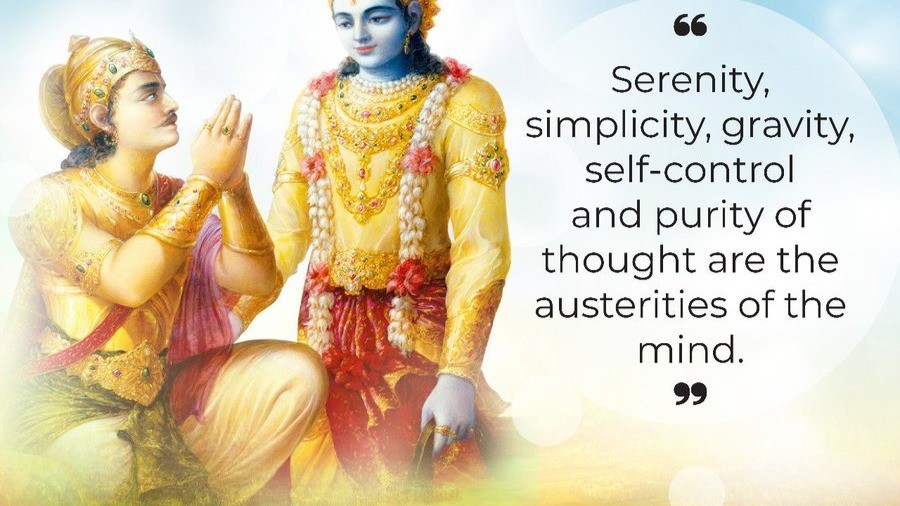
Austerities of the mind-2
WISHING ALL THE READERS MERRY CHRISTMAS
Austerity of the mind is higher than the austerity of body and speech, for if we learn to master the mind, the body and speech automatically get mastered, while the reverse is not necessarily true.
Cleaning the mind
मन:प्रसाद: सौम्यत्वं मौनमात्मविनिग्रह: । भावसंशुद्धिरित्येतत्तपो मानसमुच्यते ॥ Bhagavad Gita 17.16॥
Five essential practices are recommended for keeping the mind clean.
Manah prasadah refers to a cultivated state of inner satisfaction. The mind should be clear, calm, and light. The seeker must cultivate Sattvaguna, and keep the mind in that calm and serene state. This does not mean ignoring or suppressing one’s struggles but rather approaching life with a contented heart, where gratitude and spiritual reflection serve as anchors during turbulent times. Contentment, in this sense, becomes a foundation for a peaceful mind, enabling one to withstand the inevitable ups and downs of life without becoming unsettled.
Saumyatvam: When thoughts are gentle, accepting, and non-judgmental, the mind becomes a place of comfort rather than conflict. Gentleness is not about naivety but about refusing to succumb to bitterness or cynicism, even when faced with adversity. It is the refusal to let mental complexity or harshness rule, allowing the mind to remain supple and open—a prerequisite for spiritual insight and harmonious living.
Maunam literally means silence. Silence is about the austerity of speech. You might wonder how it is included in the list of austerities of the mind? Silence is actually about speech as well as the mind. Mere stopping the speech is useless when the mind is distracted by hundreds of worldly thoughts. The objective is to acquire perfect stillness of the mind and complete detachment, which can be achieved by meditation. Internal silence is the aim, and restraint of speech is a means to that end.
Atmavinigrahah: ‘atma’ means the mind and senses. Restraining the mind from running after worldly pleasures is Tapas in the highest sense of the word. The word ‘vinigrahah‘ implies control, the ability to direct the currents of one’s thoughts rather than being swept away by them. Desires, memories, and emotions may arise, but mental austerity empowers an individual to observe rather than act impulsively.
Bhavasamsuddhi implies perfect purity of thought and feeling, is the most subtle yet essential element of mental austerity. It is an ongoing process of examining one’s motives, ensuring that thoughts and actions are guided by sincerity rather than ego or hidden agendas. Just as a temple is regularly cleansed, so too must the mind be continually purified of selfishness and duplicity. When intention is pure, all other qualities of mental austerity are naturally enhanced, turning the mind into a sacred space where the seeds of devotion and wisdom can flourish.
#MindfulnessExercise
Central to this verse is the understanding that mental discipline is the root from which all other forms of discipline grow. If serenity, gentleness, detachment, self-control, and purity are cultivated in the mind, then the discipline of the body and speech inevitably follows. The state of the mind shapes the totality of one’s consciousness and actions.
Ultimately, the verse teaches that the highest form of austerity is internal. Outward conformity or discipline is incomplete without inner transformation. The mindfulness and intentionality brought to these five qualities create not merely a quiet mind, but a sacred one—capable of true spiritual growth, awareness, and loving devotion. In such a mind,
All five of these practices are essential for a happy life. An abundance of one quality cannot compensate for the lack of the other. Ravana is a recognised tapasvi and devotee, but that did not save him because he lacked control over the senses and purity of thought.
Complex thoughts to comprehend? Let us simplify using a story from the Ramayana in the next episode. Until then, silence of mind and purity of thoughts.
____________________________________________________________________________
#PositiveNewsPage
Adapted from newindianexpress.com
Community libraries are rewriting rural aspirations in Telangana
At a time when competitive exam coaching is costly and books remain out of reach for many, Dr Himaja Ch is leading a quiet transformation through the Hope for Life Foundation. Her idea is simple yet powerful: take libraries to places where aspiration exists but access does not. Across rural and underserved pockets of the Telugu states, the foundation has been setting up community libraries so that poverty does not extinguish a student’s dream.
With a focus on competitive exam aspirants, the libraries stock expensive exam-oriented books alongside literature and novels that encourage wider reading.
So far, three libraries have come up — at Cherlapally, Chinna Dhanvada in Mahabubnagar district, and most recently in Nandyal district of Andhra Pradesh. The Nandyal library was built with a `16 lakh donation from Epiq Systems India Pvt. Ltd., covering the full construction cost.
“For nine years, we have worked across 10 states in healthcare, education, women’s empowerment and skill development,” she says. “In the two Telugu states alone, we have supported 7,132 students.”
Each new library houses about 300 books, while the two libraries in Telangana together hold nearly 1,000 volumes. More books will be added, and another library is planned in Nizamabad district.
Beyond libraries, the foundation has provided scholarships to around 500 students from marginalised communities.
_________________________________________________________________________
Conceived, compiled and posted as a weekly motivational newsletter #MondayMusings by Jaganathan T (www.authorjaganathan.com)
_________________________________________________________________