MONDAY MUSINGS SEASON 2 - EPISODE 341
24th November 2025
20 elements of knowledge
What are the various elements of knowledge? When can we say one is knowledgeable?
We usually consider the educational qualifications and certifications as proofs of attaining knowledge. Is it actual knowledge? Don’t we see many people who demonstrate greater knowledge without formal qualifications, but who have gained it through life experience?
Lord Krishna explains these intriguing questions in #BhagavadGita slokas 13.8-13.12. The definition of knowledge spans four slokas in the #BhagavadGita.
अमानित्वमदम्भित्वमहिंसा क्षान्तिरार्जवम् | आचार्योपासनं शौचं स्थैर्यमात्मविनिग्रह: || 8|| इन्द्रियार्थेषु वैराग्यमनहङ्कार एव च | जन्ममृत्युजराव्याधिदु:खदोषानुदर्शनम् || 9|| असक्तिरनभिष्वङ्ग: पुत्रदारगृहादिषु | नित्यं च समचित्तत्वमिष्टानिष्टोपपत्तिषु || 10|| मयि चानन्ययोगेन भक्तिरव्यभिचारिणी | विविक्तदेशसेवित्वमरतिर्जनसंसदि || 11|| अध्यात्मज्ञाननित्यत्वं तत्वज्ञानार्थदर्शनम् | एतज्ज्ञानमिति प्रोक्तमज्ञानं यदतोऽन्यथा || Bhagavad Gita 13.12||
Lord Krishna’s list is not Science, Maths, etc. It is a long, different kind of list. Elements of knowledge, as per Lord Krishna are:
1. Humbleness
2. Freedom from hypocrisy
3. Non-violence
4. Forgiveness
5. Simplicity
6. Gratefulness to the Guru / Mentor
7. Cleanliness of the body and the mind
8. Steadfastness
9. Self-control
10. Dispassion toward the objects of the senses
11. Absence of egotism
12. Keeping in mind the evils of birth, disease, old age, and death
13. Detachment
14. Absence of clinging to spouse, children, home, and so on
15. Even-mindedness amidst desired and undesired events in life
16. Constant and exclusive devotion toward Lord Krishna ie Spirtuality
17. Inclination for solitary places
18. Aversion to mundane society
19. Constancy in Self-awareness
20. Philosophical pursuit of the Absolute Truth
Humbleness. We have seen enough in the earlier episodes of #MondayMusings that a balance is required between humility and hubris. My book #GrandmaInTheBoardRoom has a chapter dedicated to Humility. Knowledge can be attained only by being humble.
Freedom from hypocrisy. The hypocrite develops an artificial external personality. A person is defective from the inside but creates a facade of virtuosity on the outside.
Non-violence. The cultivation of knowledge requires respect for all living beings. This involves the practice of non-violence. Hence, the scriptures state: ātmanaḥ pratikūlāni pareśhāṁ na samācharet “If you dislike a certain behaviour from others, do not behave with them in that manner yourself.”
Forgiveness. Harbouring ill will harms oneself more than the harm possible from any person. By practising forgiveness, one can release the negativities in the mind, thus purifying it.
Simplicity. It is straightforwardness in thought, speech, and action. Straightforwardness in thought includes the absence of deceit, envy, crookedness, etc. Straightforwardness in speech comprises the absence of taunt, censure, gossip, ornamentation, etc. Straightforwardness in action includes plainness in living, forthrightness in behaviour, etc.
Being grateful to the Guru / Mentor – By being thankful to our guides, we value the knowledge they share.
Cleanliness of body and mind. Purity should be both internal and external. The mind can be purified by developing positive thoughts.
Steadfastness. Goals are not attained in a day. Steadfastness is the persistence to remain on the path until the goal is reached. The scriptures state: charaivaite charaivate, charan vai madhu vindati “Keep moving forward. Keep moving forward. Those who do not give up will get the honey at the end.”
Self-control. It is the restraint of the mind and the senses from running after mundane pleasures that dirty the mind and the intellect. Self-control prevents the dissipation of the personality through indulgence.
Dispassion toward the objects of the senses. It is a stage higher than the self-control mentioned above, in which we restrain ourselves by force. Dispassion means a lack of taste for sense pleasures that are obstacles to growth.
Rest in the next episode.
____________________________________________________________________________
#PositiveNewsPage
Adapted from newindianexpress.com
Nestled deep in the folds of the Jawadhu Hills in Tamil Nadu, the Panchayat Union Middle School, Kurumalai, was barely operational when Ms Saraswathi arrived as its headmistress 11 years ago. Not now. Kurumalai lies four kilometres from the foothills and remains cut off from bus services. The rocky forest paths can be navigated only on bikes. At the time, barely four teachers and around 20 of the 70 enrolled students attended school. Saraswathi herself had not imagined landing in such a remote outpost.

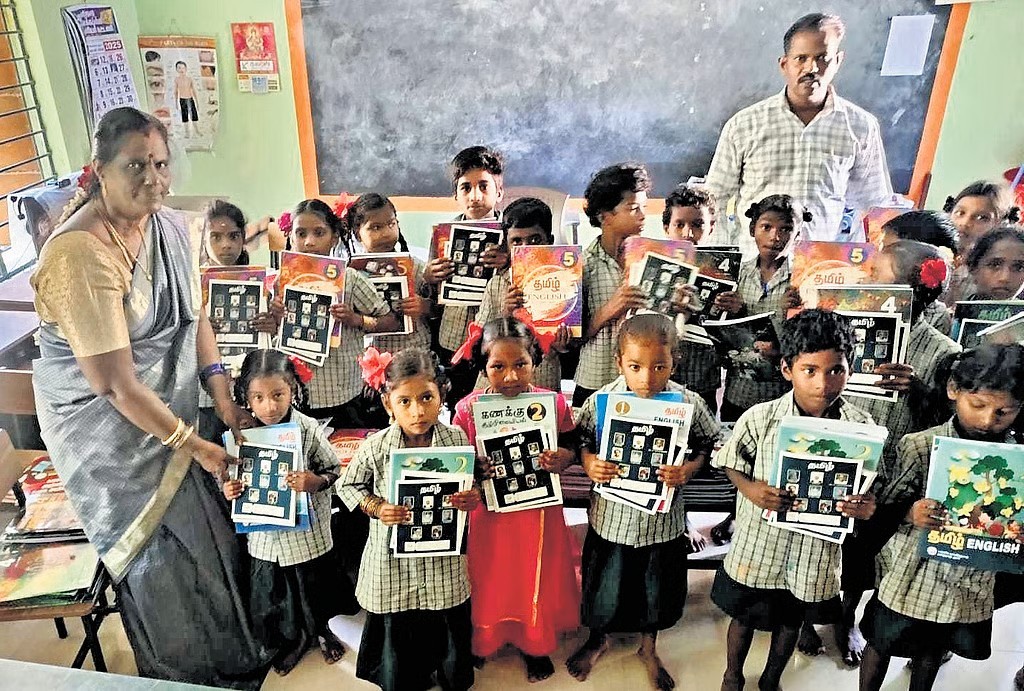
HM Saraswathi with her students in Kurumalai after delivering new books she carried up the hill, Courtesy - New Indian Express
As a child, she dreamt of becoming a collector, but with little guidance and an early marriage at 20, her path was diverted to teaching. Her career began in 1988, and she was promoted in 2010 and posted to a middle school in the Palamathi Hills — an institution she helped upgrade to a high school within five years. And then, in 2014, came the call to Kurumalai. Friends and relatives discouraged her, warning of isolation, wildlife and poor infrastructure.
But Saraswathi chose the hills. From her home in Thorapadi, she rode nearly 15 kilometres every day, climbing 1,820 feet and navigating dirt tracks, hairpin bends, the occasional bear, and venomous snakes. “Earlier, there wasn’t even a proper road. Only in 2022 the bitumen road was laid after several representations,” she recalls. Over the past three years alone, the school’s strength has risen to 92 students, with full attendance slowly becoming the norm and dropout rates dropping sharply.
Kurumalai, home to the Malayali tribal community, follows a rhythm shaped by tradition. Festival weeks often kept children away from the school. Saraswathi did not force change; she nudged it. Walking hamlet to hamlet, she met parents where they were — on fields, at doorsteps, sometimes on forest trails. “I tell parents how important education is,” she says.
Her efforts have also reshaped the lives of young girls. Child marriage, once common in these hamlets, has declined as education opened new possibilities. Saraswathi proudly speaks of Radhika, a final-year BSc Zoology student poised to become Kurumalai’s first graduate. For parents, her commitment became impossible to ignore. “When ma’am comes this far and takes classes to improve our lives, how can we not send our children?” asks R Madhavi, a resident. Even after earning the community’s trust, Saraswathi’s concerns remain practical and urgent. She is relentlessly pursuing broadband access for the school, pushing telecom providers to install a tower. “Right now, we walk nearly a kilometre just to catch a signal to mark attendance or complete online work,” she says. She also dreams of securing government support to provide bikes so students need not walk three steep kilometres every day. Bearing the name of Saraswati, the Hindu goddess of learning, she became an unquenchable flame — small, stubborn, defiant — lighting not only classrooms but entire futures.
________________________________________________________________________________
Conceived, compiled and posted as a newsletter #MondayMusings every Monday by Jaganathan T (www.authorjaganathan.com)
______________________________________________________________________